
Key takeaways
-
01
Three things decide how a pattern reads: how big the repeat is, how far the pattern colour sits from the ground, and how tightly it recurs. The names are combinations of those three.
-
02
At two metres, a low-contrast pattern reads as a plain suit with depth, and a high-contrast one reads as a patterned suit. Judge cloth at that distance, not at arm’s length.
-
03
A Glen check is the houndstooth and twill grid on its own. Add a fine contrasting line over the top and it becomes a Prince of Wales check.
-
04
Fine herringbone, birdseye and nailhead are safe in any business setting. Gun club, large houndstooth and plaid aren’t.
-
05
When mixing patterns, vary the scale. Two patterns at similar scale fight each other, and a fine-striped shirt against a pinstripe suit is the most common error.
Suit patterns are the designs woven into the cloth itself: the stripes, checks and textures that give a suit character without changing its shape. If your wardrobe is plain navy and charcoal and you want the next suit to have a bit more to it, a pattern is the obvious next step, and the names are where most men get stuck.
There are eleven worth knowing. Here's what each one is, what it says about you, which scale suits your build, and where it works, from the office to a wedding. They're the cloths men actually weigh up in our fittings, including the ones they end up talking themselves out of.
Stripes: Pinstripe · Chalk stripe
Checks: Glen check · Prince of Wales check · Windowpane · Houndstooth · Gun club · Plaid
Woven patterns: Herringbone · Birdseye · Nailhead
How Pattern Changes the Way a Suit Reads
Every pattern on this list is a mix of three things.
Scale is how big the repeat is. It decides how the pattern reads at conversational distance.
Contrast is how far the pattern colour sits from the ground colour, which is the base colour of the cloth. It decides how loud the pattern is.
Repeat is how tightly the pattern recurs across the cloth. A tight repeat reads as texture from three metres away, while a wide one reads as pattern.
Put the three together, and you get the one test that matters. At two metres, a low-contrast pattern reads as a plain suit with a bit of depth, and a high-contrast one reads as a patterned suit. That distinction decides almost everything else about which pattern you choose and where you can wear it.
Stripes
Stripes run vertically, and they read formal and urban. The only real difference between them is how the stripe is made.

Pinstripe
A pinstripe is a very fine line, roughly the width of a pin, woven into the cloth at regular intervals. It's almost always white or a light tone against a dark ground.
It's the most formal and the most business-coded pattern there is, and it carries the strongest associations of any on this list. The spacing matters more than the stripe itself. Narrow spacing reads conservative, wide spacing reads deliberate, and very high contrast is where it tips into costume.
Chalk Stripe
A chalk stripe is wider and softer-edged than a pinstripe, as though it's been drawn on with tailor's chalk. It's most at home on flannel rather than worsted, where the brushed surface softens the line even further.
It reads softer and more traditional than a pinstripe, and it's the better choice for a winter suit, because it sits naturally on the heavier cloths that winter calls for.
Checks
Checks run in both directions. Depending on scale and contrast, they range from almost invisible to impossible to miss.

Glen Check and Prince of Wales Check
A Glen check and a Prince of Wales check are related but not the same, and there's a simple way to tell them apart. A Glen check is an alternating grid of small houndstooth and fine twill blocks, on its own. The moment a fine contrasting coloured line runs through that grid, it's a Prince of Wales check.
That extra line is called an overcheck: one check laid over another so both stay visible. So every Prince of Wales check is built on a Glen check, but not every Glen check is a Prince of Wales. Both come in a wide range of scales, from fine business cloths to bolder versions that read more country.
The pattern began in the 1840s as a Scottish estate check, one of a family of district checks, and took the Prince of Wales name through royal adoption. It's the most versatile of the checks, and the one that works in a business setting and at a wedding alike.
Windowpane
A windowpane check is made of widely spaced single lines that form large open squares, like the panes in a window, with nothing inside them.
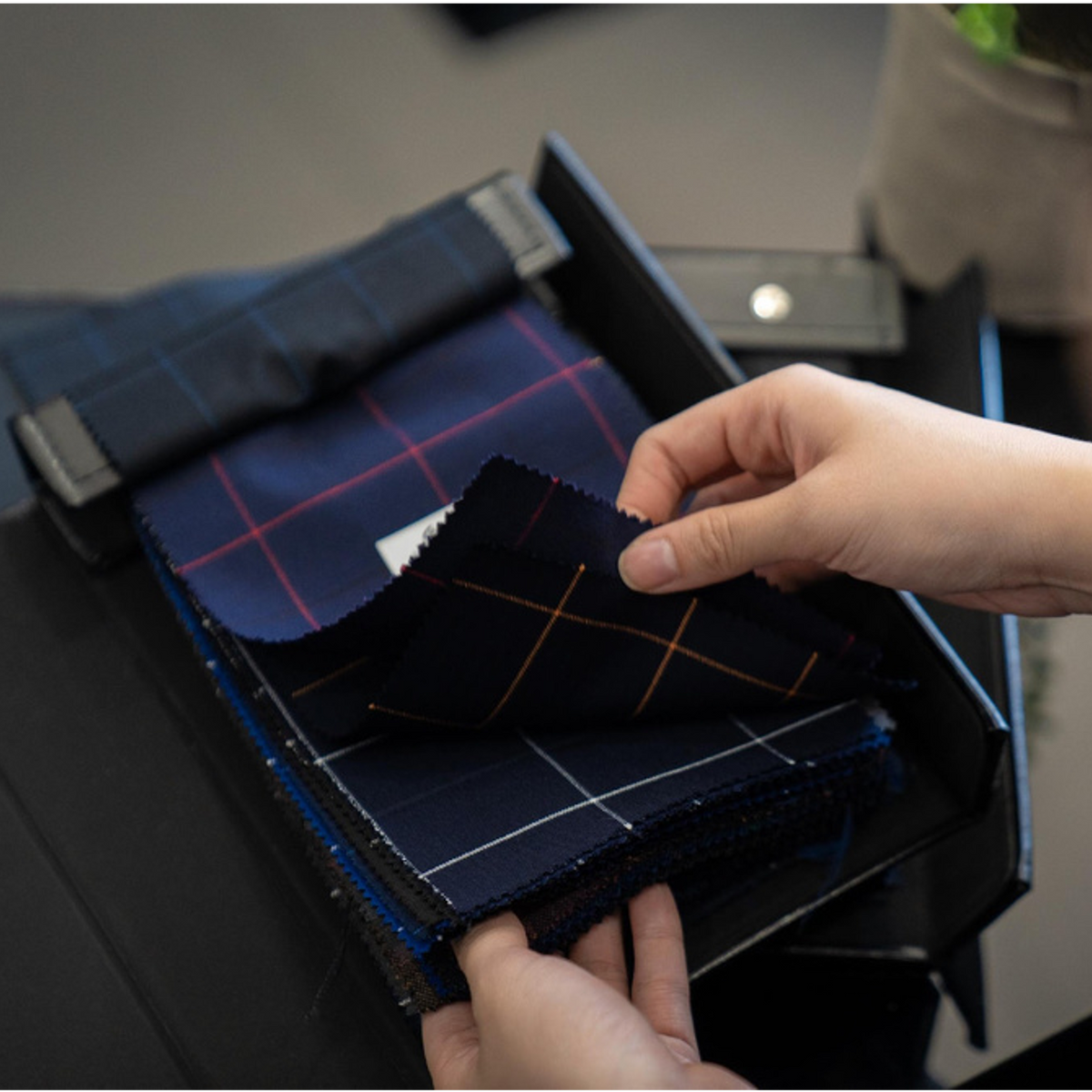
It's the boldest check you can still wear to work, and it's the one that depends most on getting the scale right for your build. A narrow, low-contrast windowpane on navy or charcoal reads confident and still professional. A large, high-contrast one is a statement.
Houndstooth
Houndstooth is a small broken check with pointed, jagged edges, traditionally in high-contrast black and white.
No pattern changes character with scale as much as this one. Fine houndstooth reads as texture and is easy to wear almost anywhere. Large houndstooth reads as a statement, and it's the hardest pattern on this list to wear well.
Gun Club
A gun club check is a check in two colours over a lighter ground, and like the Glen check, it began as a Scottish district check.
It reads country rather than city. Of everything on this list, it's the least suited to a business setting, and it's at its best as a sports jacket or a weekend suit in a heavier cloth, where the country associations are the point.
Plaid
Plaid is the broad term for a pattern of crossing bands in several colours. In Australian and British usage, "check" covers most of what Americans would call plaid, which is why the two words get used interchangeably.
It's the most casual pattern in the group, and it relies on colour restraint more than any other. A muted plaid in two or three close tones can work as a relaxed suit, while a bright, multi-colour one belongs on a weekend jacket.
Patterns Woven Into the Cloth
These last three aren't printed or applied. The effect comes from the way the yarn is woven, which is why they read as texture from a distance and only show as pattern up close. There's more on how weave changes the way a cloth wears in our suit fabric guide.

Herringbone
Herringbone is a broken twill that reverses direction at regular intervals, making a V shape that looks like the skeleton of a fish.
It's the most versatile of the woven patterns. At normal distance it's effectively a plain suit with depth, so it works almost anywhere. Fine herringbone is safe in any business setting, while broad herringbone reads country and a bit tweedy, and it's better kept for the weekend.
Birdseye
Birdseye is a pattern of tiny dots made by the weave, each with a lighter centre, so the cloth reads as one soft tone from a distance.
It's quietly formal. If your first navy suit is plain and you want the second to be different without announcing it, birdseye is the one to look at.
Nailhead
Nailhead is close to birdseye, and the two get confused all the time. It's also a small woven dot, but it's squarer and slightly larger, like the head of a nail.
It has the same quiet formality as birdseye and it's marginally more visible, so it's a good pick if you want the texture to register at conversational distance rather than only up close.
Matching Pattern Scale to Your Build
The principle is proportion: the scale of a pattern should sit in proportion to your frame. A large repeat on a small frame overwhelms it, and a very fine repeat on a large frame disappears and does nothing for you.
Direction matters too. Stripes draw the eye up and down and checks draw it across, so a broad check adds visual width where a stripe doesn't. If you're broad through the chest and would rather look longer than wider, a stripe or a fine woven pattern will do more for you than a bold check.
The test you can run yourself is distance. Look at the cloth from about two metres away, which is how far most people will see you from, rather than at arm's length.
That's also the mistake we see most in fittings. Men choose a pattern at arm's length under shop lighting, where a bold check looks lively and a fine one looks like nothing, then they're caught off guard by the bold one in a photo. Step back from the swatch before you decide.
Business or Wedding: Which Patterns Work Where
Here's how the eleven sort for business suits:
- Safe in any business setting: fine herringbone, birdseye, nailhead, narrow pinstripe, fine Prince of Wales.
- Business-capable with judgement: windowpane, larger Prince of Wales, chalk stripe, fine houndstooth.
- Weekend, country or social only: gun club, large houndstooth, plaid, and anything high contrast.
Weddings work differently, and it depends which side of the aisle you're on. A guest has more latitude than a groom. A groom in a strong pattern will be photographed in it for the rest of his life, so if it's your wedding, lean toward the safe tier and bring the pattern in through the waistcoat or tie instead. Our wedding suits start from that conversation.
There's also an Australian catch. A patterned suit in a heavier cloth looks right at a winter wedding and becomes a problem at a summer one, but that's a cloth-weight question rather than a pattern one. The same Prince of Wales works in either season if the cloth is right.
Mixing a Patterned Suit With a Patterned Shirt or Tie
The rule that actually works is to vary the scale. Two patterns at clearly different scales look deliberate, and two at the same scale fight each other and look like a mistake.
In practice, the suit's pattern is the largest, so the tie should be noticeably smaller or noticeably larger than it, and the shirt should be the quietest of the three.
If you don't want to think about it, there's a default that works in every setting: a patterned suit with a plain shirt and a textured or small-figured tie.
The single most common mistake is a fine-striped shirt under a pinstripe suit. The two stripe widths are close enough that they shimmer against each other, and it shows from across a room.
Most men can carry two patterns comfortably. Very few can carry three, and if you're not sure which group you're in, you're in the first one.
Choosing a Pattern with Lupo Bianco
Two things decide whether a pattern works: scale decides whether it flatters you, and contrast decides how loud it is. The names come after both.
At our Strathfield studio, we'll put the cloths in front of you and then step back, so you see them at a realistic distance rather than under your nose. Pattern is a decision best made with the cloth in hand, and it's part of the fitting conversation. You can browse our fabric range first, or book a consultation and we'll narrow it down together.