
Key takeaways
-
01
The label matters less than how your pattern is made. Ask whether it’s drafted for you.
-
02
A rounded back or a dropped shoulder is where an adjusted pattern runs out of answers.
-
03
With an expensive cloth, a trial suit in cotton means the cloth is only cut once.
-
04
“Bespoke” on a label isn’t a guarantee. The fittings tell you more than the word.
-
05
For a working wardrobe on a deadline, made to measure is the sensible call.
The real difference between made to measure and bespoke is the pattern. A made-to-measure suit adjusts an existing pattern to your measurements; a bespoke suit is cut from a pattern drafted for you alone, then tested on your body before it's finished. That's the short answer to made to measure vs bespoke, but tailors use both words loosely, so it pays to know what to ask rather than trust the label. The clearest place to see the difference is the muslin fitting, where a trial suit shows how a pattern sits on one particular body. Our senior tailor, Richard Song, takes you through one in the video further down.
Made to Measure vs Bespoke at a Glance
Bespoke vs made to measure, side by side:
| Made to measure | Bespoke | |
|---|---|---|
| Pattern | An existing block pattern, adjusted to your measurements | Drafted from scratch for you |
| Posture | Limited corrections | Built into the pattern |
| Trial garment | Usually none | A muslin or a basted fitting, depending on the tailor |
| Fittings | Usually one or two | Several |
| Construction | Varies, from fused to full canvas | Usually full canvas, with more hand stitching |
| Price | Lower | Higher |
These are the traditional definitions. In practice, tailors use the words loosely, so the questions further down tell you more than the label does. If the construction row is unfamiliar, our guide to full canvas, half canvas and fused jackets explains what's inside the front of each.
What Is Made to Measure?
Made to measure is a suit cut from the tailor's existing pattern, adjusted to your measurements and the details you choose. That existing pattern is called a block: a standard shape, graded across sizes, that the tailor alters rather than starts from blank paper.
Within that block, a lot can change. The tailor can adjust the sleeve and trouser lengths, the jacket length, the waist and chest, and make some changes to the shoulders. You choose the cloth, the lapels, the buttons, the lining and the rest of the details, so the suit is still yours in every way you'd notice.
Its limits come from where it starts. Because the block was drawn for a standard body, made to measure struggles with the things a standard body doesn't have: a dropped shoulder, a rounded back, or a noticeable difference between the two sides of the body. A good tailor can correct some of that, but there's only so far a pattern can be pulled before the balance of the jacket goes.
Made to measure suits men with fairly standard proportions, anyone on a tight timeline, and anyone building a working wardrobe of several suits, where a consistent, well-fitted shape matters more than a pattern drawn from nothing.
What Is a Bespoke Suit?
A bespoke suit is made from a pattern drafted from scratch for one person, then refined over a series of fittings. The word comes from "bespeak", to order something in advance, which is what bespoke tailoring has always meant: the suit doesn't exist until you've spoken for it.
The Savile Row Bespoke Association, the trade body for the London tailors who built the tradition, defines it by three things: a pattern made specifically for the customer, cut by an individual, and a series of fittings.
The word itself is used far more loosely. In 2008, the UK's Advertising Standards Authority ruled that a retailer could describe suits made to a customer's measurements as bespoke, even though they weren't cut from a new pattern by hand. So "bespoke" covers a wide range, and the only way to know what you're getting is to ask how the pattern is made.
Does bespoke mean high end? Not by itself. It means made for you. A bespoke suit is usually dearer because of the extra drafting and fittings, but the word isn't a quality grade, and a well-made suit in a good cloth matters more than what's written on the label.
The Muslin Fitting: Where the Difference Shows
A pattern made for one body has to be tested on that body before the real cloth is cut, and a muslin fitting is one way tailors do it. It's one stage of a longer suit-making process, but it's the stage where a drafted pattern earns its keep.
What Happens at a Muslin Fitting
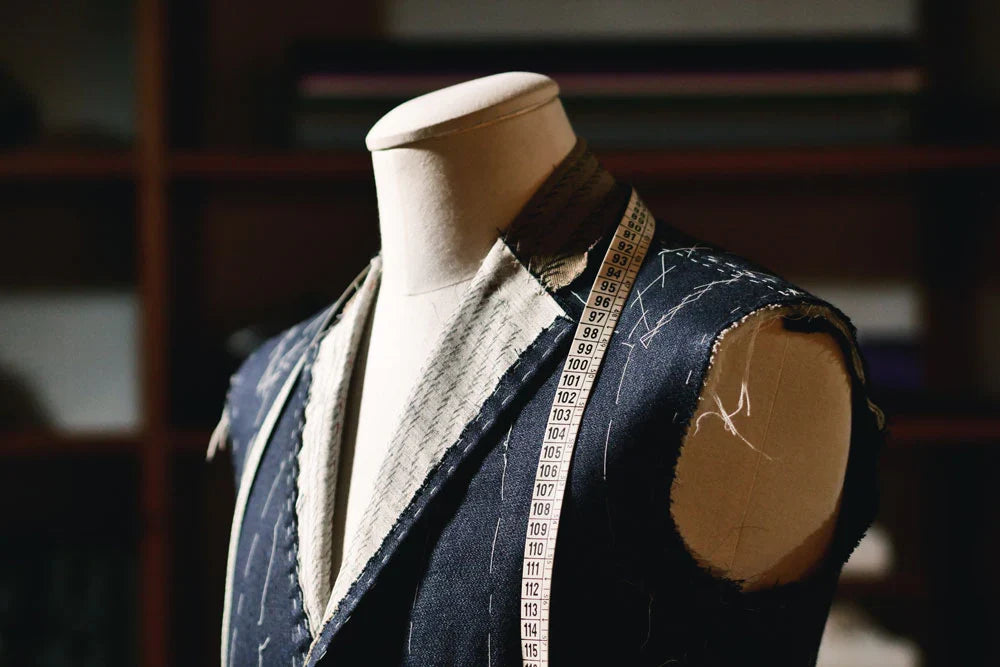
A muslin fitting uses a trial suit made in plain cotton muslin, fitted on you before the real cloth is cut. Richard is clear about when it's worth doing:
“We usually recommend this when you’re investing in higher-end fabrics.”
The reason is simple. With higher-end fabrics, the expensive cloth is only cut once the fit is right, so any mistakes are made in cotton.
What the tailor reads at a muslin fitting is your posture: a rounded back, a sloping shoulder or a raised hip. Then the balance of the jacket across the shoulders, chest and back, which is how evenly it hangs from front to back and side to side. As Richard puts it:
“That lets us see exactly how it sits on your body, your posture, your movement, and how everything balances.”
Adjustments are marked straight onto the muslin in tailor's chalk, then pinned to refine the shape and proportions. According to Richard:
“This is where we perfect the details that most people don’t even notice.”
Those details are the balance of the shoulder, the comfort of the armhole (the opening where the sleeve joins the body), and how the suit sits when you move rather than when you stand still. Our guide to how a suit should fit explains what that balance looks like on a finished suit.
Muslin Fitting vs Basted Fitting
A basted fitting tests the pattern in the real cloth instead. The suit is cut in the actual cloth and loosely tacked together with white basting thread, so it can be taken apart and recut after the fitting.
The difference is what's at stake. A muslin tests the fit in cheap cotton before the cloth is touched; a basted fitting tests it in the cloth itself, so you see how that cloth drapes. Some tailors use one, some use both, and the number of fittings varies between them.
Which Should You Choose?
Is bespoke worth it over made to measure? It depends on your body and the cloth, not just your budget.
Made to measure suits you if your proportions are fairly standard, if you're working to a tight timeline, or if you need several suits for work. A well-cut made-to-measure suit in a good cloth is a better buy than a bespoke label on a rushed job, and for most working wardrobes it's the sensible call.
A pattern drafted for you, or a muslin stage, earns its place in three situations:
- Your posture is one standard patterns don't account for, such as a rounded back, a dropped shoulder or a noticeable difference between your two sides.
- It's an occasion suit you'll keep for years, such as a wedding suit, where getting the fit exactly right is worth the extra fittings.
- The cloth is expensive enough that you don't want it cut twice.
If none of those apply, you're unlikely to see the difference in the mirror, and you'll have the suit sooner.
Questions to Ask Any Tailor
Because the labels are used loosely, these four questions tell you what you're actually getting:
- Is my pattern drafted for me, or adjusted from one you already have? This is the real difference between the two methods, whatever the suit is called.
- How many measurements do you take, and do you note posture? A tailor who records how you stand, not just your sizes, can correct for it in the pattern.
- How many fittings will I have, and is there a trial suit or a basted fitting before the cloth is finished? Fittings are where a pattern is tested and refined; the more complex your fit, the more they matter.
- How long will it take? A drafted pattern and extra fittings take longer, so check the timeline works for your date before you choose.
Having Your Suit Made at Lupo Bianco
Every suit we make starts with a custom pattern created from at least 18 measurements of your body. You'll have a first fitting and a final fitting, and when you're investing in higher-end fabrics, we recommend a muslin trial suit before the cloth is cut. Our suits are hand-made by master tailors, with standard delivery of about 4 to 6 weeks and express available on request. As Richard puts it:
“If you’re investing in a custom suit, this is how you ensure that it’s done properly.”
Bring your questions to a consultation. We'll talk through your build, your cloth and your timeline, and tell you whether a muslin fitting is worth it for your suit. Book a consultation now.

Made for you
Explore our custom suits
Every suit starts with a custom pattern from at least 18 measurements.
View custom suits