
Full Canvas vs Half Canvas vs Fused: How to Tell What You're Buying
Key takeaways
-
01
The price gap between two similar-looking jackets usually comes down to one hidden layer, and whether a machine glued it in or a person sewed it in.
-
02
A canvassed jacket improves with wear, gradually taking the shape of your chest and shoulders. A fused one is the same on day one and day one thousand.
-
03
You don’t need a tailor to tell the difference. A thirty-second check at the rack will tell you which construction a jacket has.
-
04
Glue fails eventually. When it does, the jacket front ripples, there’s no fixing it, and that’s the real reason construction matters.
-
05
If the budget’s stretched, put it into fit before construction. A canvassed jacket that doesn’t fit you is a worse buy than a fused one that does.
The difference between a fused, a half canvas and a full canvas suit comes down to one layer inside the front of the jacket, and whether it's glued in or sewn in. Almost everything else, from how the jacket drapes to how long it lasts, follows from that.
It's why two jackets can look the same on the rack, sit at similar prices, and still have one described to you as better made. A fused jacket has that layer glued in, a half canvas jacket has it sewn through the chest, and a full canvas jacket has it sewn the whole way down.
We sew canvas into jackets for a living, so here's what each one does, how to check a jacket yourself, and when the upgrade's worth paying for. David, one of our tailors, puts the case in one line:
“If you’re buying a suit, this one detail can completely change the way it fits, drapes, and lasts. And most people don’t even know it’s there.”
Jump to: Fused · Half canvas · Full canvas · The thirty-second check
What Canvas Actually Is
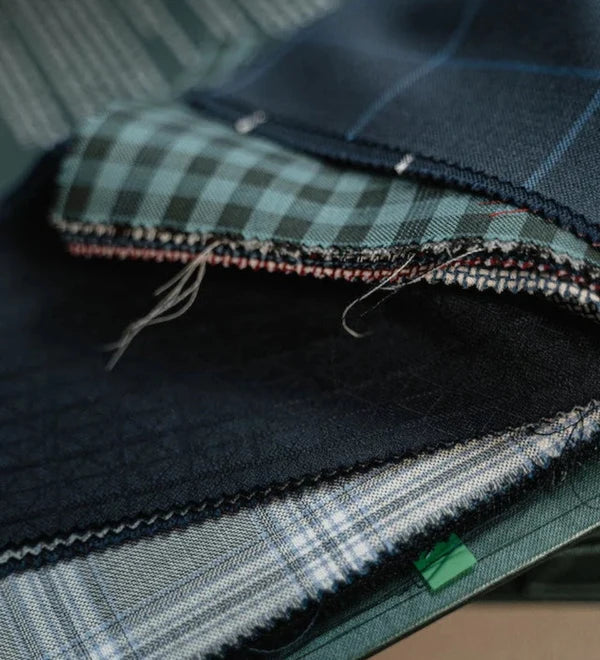
Canvas is a layer of stiffened cloth, traditionally woven with horsehair, that sits between the outer cloth and the lining in the front of a jacket. It's what gives the front its shape.
On its own, suit cloth is flat and soft, and without something behind it, a jacket front would hang like a shirt. The canvas is what lets it hold the curve of a chest and the roll of a lapel. David on why it matters:
“Canvassing is the construction of the jacket between the outer fabric to the lining. While you can’t see it from the outside, it plays a huge role in how it holds its shape and moves with your body.”
How it's attached is the part that matters. Sewn canvas floats: it's held to the cloth by stitching rather than bonded to it, so the two layers can move independently. With months of wear, body heat and movement, that floating layer settles into the shape of your chest and shoulders, which is why a canvassed jacket gets better the more you wear it. A glued layer can't move, so it can't mould.
The stitching that attaches the canvas to the cloth, and shapes it as it goes, is called pad stitching. It can be done by hand or by machine.
What separates the three types is how far down the front that layer runs.
The Three Ways a Jacket Front Is Built
These aren't really quality tiers so much as three different ways of doing the same job. The price gap between them is mostly labour, not materials.

Fused
Fused construction is the fastest and most consistent of the three, which is why it dominates off the rack. David explains:
“This uses synthetic interlining that’s heat-pressed and bonded to the outer fabric. It is the most affordable option and is mostly found in off-the-rack suits.”
Because the interlining is bonded across the whole front, the cloth can't move independently of it. The jacket drapes a little stiffer, breathes a little less, and doesn't mould to you over time.
The real issue is longevity. Over years, and faster with heat and repeated dry cleaning, the adhesive can let go of the cloth. When it does, the front develops ripples or bubbles you can see from across a room. That's called delamination, and it can't be properly repaired.
To be fair to it, a well-made fused jacket in good cloth, worn a handful of times a year, may never bubble at all. For an occasional suit, fused is a perfectly reasonable buy.
Half Canvas
Half canvas puts sewn canvas where the shaping matters most, and fuses the rest.
“Half canvas is done with horsehair, wool, and cotton. It goes from the lapel to the bottom part of your chest, while the rest of the jacket still remains fused.”
That blend of horsehair, wool and cotton gives the canvas enough spring to hold a shape and enough softness to move with you. Running it from the lapel down through the chest means the parts people actually look at, the lapel roll and the chest, get the benefit of a floating layer. The lower front, which does less shaping work, stays fused.
That's the whole logic of it: put the labour where you'll see it and keep the cost down. You get a lapel that rolls rather than creases and a chest that moulds over time, at a price well short of full canvas.
For most men, most of the time, it's the one to choose. It gives you most of what canvas does for the way a jacket looks and wears, without paying for hours of work in the part of the jacket that does the least shaping.
Full Canvas
Full canvas takes the same approach the whole way down. As David describes it:
“Full canvas uses the same materials as a half canvas. However, it runs down from the jacket lapel all the way down to the hem.”
With no fusing anywhere, the whole front floats. The jacket moulds to you over years rather than months, it drapes more naturally from chest to hem, and because nothing is glued, it can be pressed and altered more freely without any risk to a bond.
What it costs is hours. Sewing canvas through the entire front, and shaping it as you go, takes far more labour than either of the other two, and that's where the price sits. The materials aren't the expensive part.
It's the best construction there is, but it isn't the right purchase for everyone. Whether it's right for you depends on how often you'll wear the suit, which we get to below.
How to Check a Jacket Yourself in Thirty Seconds
You don't need to take anyone's word for it. This is the pinch test, and you can do it standing at a rack.
- Pinch the front. Take the front of the jacket between your thumb and forefinger, below the buttonhole and away from the lapel.
- Roll the layers apart. Gently rub them against each other. If you can feel three distinct layers, with a loose middle one moving on its own, there's canvas there. If it feels like one stiff board, it's fused.
- Check high, then low. Repeat near the chest and again near the hem. Canvas at the chest but not the hem means half canvas. Canvas at both means full canvas.
- Look at the lapel. A canvassed lapel curves softly as it rolls towards the button. A fused one is more likely to crease flat, like a fold in paper.
- Look across the front. Any rippling or bubbling means the fusing has already started to fail.
What the test can't tell you is the quality of the canvas itself, or whether it was sewn by hand or by machine. For that you'll have to ask, and anyone confident in their construction will be happy to show you.
What the Difference Is Worth
The canvas itself isn't expensive. The labour to sew it in is, and hand pad stitching adds more again. So the question isn't really whether canvas is better. It's whether you'll wear the suit enough to get that labour back.
That comes down to use rather than budget:
- A suit you wear once or twice a year has little to gain from full canvas. Delamination is driven by wear and cleaning, so an occasional suit may never reach the point where the construction shows.
- A suit in weekly rotation for a decade is where full canvas pays for itself, because it keeps moulding to you and has no glue to fail.
- Everything in between, which covers most suits for most men, is where half canvas is the right answer.
The most useful thing to know is the order to spend in: fit first, then cloth, then construction. Construction is the last upgrade worth paying for, not the first.
What Canvas Does Not Fix
Canvas is construction, not fit. A full canvas jacket cut badly will look worse than a fused jacket cut well, and no amount of internal structure fixes a shoulder that's too wide or a jacket that's the wrong length.
It doesn't change the cloth, the pattern, the shape of the lapel or how well the seams are finished either. Those are separate decisions, and the cloth in particular does more for how a suit looks than the construction behind it. There's more on that in our suit fabric guide.
So if you're choosing between a fused jacket that fits you properly and a canvassed one that doesn't, take the fit, every time. We'd say that even though canvassing is what we do, because the jacket that fits is the one you'll actually wear.
“But the biggest difference is not the machine at all. Our canvassing is done by hand.”
Built by Hand at Lupo Bianco
Two things worth remembering: The difference between these jackets is a single layer that's either sewn or glued, and you can check which one you're looking at in thirty seconds.
Half canvas is our standard, full canvas is available as an upgrade, and both are sewn by hand, which lets the tailor shape the roll of the lapel as the stitching goes in. Come into our Strathfield studio and do the pinch test on a finished jacket yourself. Book a consultation and we'll show you what's inside.
Frequently Asked Questions
Can a fused jacket be repaired once it starts to bubble?
Not properly. Once the adhesive has let go of the cloth, the bond can't be restored. A steam press can flatten the bubbles for a while, but they come back, because the glue underneath has already failed. If a fused jacket you love has started to ripple, the realistic options are to live with it or replace it.
Are off-the-rack suits ever full canvas?
Yes, at the top end, but it's rare. Most off-the-rack suits are fused, a smaller share at higher prices are half canvas, and full canvas off the rack sits at luxury prices. The pinch test will tell you which one you're holding, whatever the label or the price tag says.
How long should a canvassed jacket last?
With rotation and reasonable care, a canvassed jacket in good cloth can last a decade or more. The canvas itself rarely fails. What wears out first is the cloth, at the elbows, cuffs and seat, which is why the cloth you choose and how often you wear the suit matter as much as the construction.
Does a canvassed jacket need different care?
Mostly the same care as any good jacket, with one advantage: there's no glue to damage. Hang it on a shaped hanger, brush it after wearing, and give it a day off between wears so the canvas and cloth can settle. Steam rather than press hard, and dry clean it sparingly, since cleaning is harder on the cloth than on the canvas.