
Key takeaways
-
01
Laces tucked under the front make a shoe dressier. That one detail is why an Oxford outranks a Derby.
-
02
A brogue isn’t its own shoe. It’s an Oxford or Derby with punched decoration, and the more of it there is, the more casual the shoe.
-
03
With charcoal or black, wear black. Brown shoes belong with navy, blue and lighter suits.
-
04
Suede turns any shoe casual. A leather loafer can go to work; a suede one shouldn’t.
-
05
Patent leather is for a tuxedo and nothing else.
Men's dress shoes decide how a suit reads before anyone notices the cut or the cloth. A polished black Oxford makes a navy suit look like a board meeting; a suede loafer turns the same suit into something for a long lunch.
There are seven types of dress shoes worth knowing, and once you can tell them apart, choosing the right pair gets simple. The other half of the decision is the suit itself, because a pair that looks right with navy can look wrong with charcoal. Our senior tailor, Scott Grant, runs through all seven in the video below.
Jump to: Oxford · Derby · Oxford vs Derby · Monk strap · Loafers · Chelsea boots · Brogues · Patent leather · Which shoes with which suit
What Makes One Dress Shoe More Formal Than Another
A dress shoe's formality comes down to two things: how it fastens and how it's finished. Closed laces and a high shine sit at the formal end; slip-ons, buckles and suede sit further towards casual.
Fastening, from most formal to most relaxed:
- Closed lacing. The Oxford, where the lacing is stitched in under the front of the shoe.
- Open lacing. The Derby, where the lacing sits on top and opens outwards.
- Buckles. The monk strap, with one or two straps in place of laces.
- Slip-on. The loafer, with nothing to fasten at all.
- Elastic sides. The Chelsea boot, which pulls straight on.
Finish, from most formal to most relaxed:
- Patent. A lacquered, mirror-like shine. Black tie only.
- Polished leather. Smooth leather with a shine built up by polish. The business finish.
- Suede. Leather with a soft, brushed surface. Relaxed, whatever the shoe.
Put the two together and most of the order explains itself. A polished black Oxford is about as formal as a shoe gets short of patent; the same Oxford in tan suede belongs at the weekend. A shoe can only be as dressy as the more casual of its two choices.
It also explains why the types of formal shoes make a short list. Formal shoes are simply the dressiest dress shoes, the closed-lace and patent end of the range.
The Main Types of Men's Dress Shoes
Of all the types of shoes for men, these are the seven that belong with a suit, running roughly from most formal to most relaxed. The brogue is the odd one out. It's a detail rather than a shoe, and its entry explains why.
Oxford
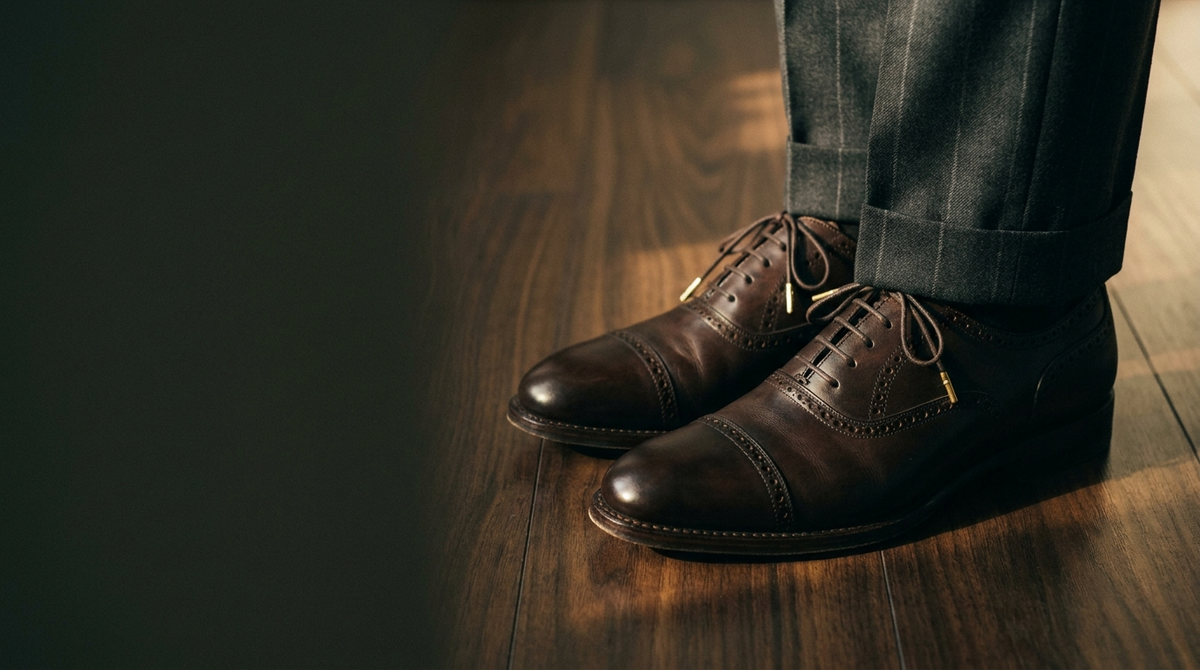
The Oxford has closed lacing. Its eyelet tabs, the two flaps that carry the laces, are stitched underneath the front of the shoe, so they sit flush and close almost flat against each other. That gives it the cleanest, sleekest line of any laced shoe.
Two versions are the plainest. The cap toe has a single stitched line across the toe, and the wholecut is cut from one piece of leather, with no seams across the top at all, which makes it the sleekest of the lot. Scott puts the Oxford at the top of the range:
“Oxford: It’s the most formal, perfect for business and black-tie occasions.”
For black tie, that means a particular Oxford: black patent, or plain black leather polished to a high shine. A brogued Oxford or a brown one isn't right with a tuxedo. For business, a cap toe is the classic, and it's a sharp choice if you're working out what to wear to the races.

Derby
The Derby has open lacing. Its eyelet tabs are stitched on top of the front of the shoe, so they sit proud and spread apart when you loosen the laces. That opens the shoe wider, and makes it easier to fit over a broader foot or a higher instep. It looks a little sturdier than an Oxford, and a little less formal. In Scott's words:
“Derby: An everyday all-rounder, slightly more relaxed, but just as versatile.”
It's the more relaxed everyday shoe of the two, and in polished black or dark brown leather it still works with a business suit.

Oxford vs Derby: How to Tell Them Apart
Look at where the laces sit. If the eyelet tabs disappear under the front of the shoe, it's an Oxford; if they sit on top and open outwards, it's a Derby. Everything else, from the toe to the colour, can be identical, which is why the two get mixed up so easily.

For a suit, the choice follows the occasion. The Oxford is the shoe for the most formal suits, and the only laced shoe for black tie. For business, either works, and the Derby is the better everyday shoe if you have a broader foot.
Are Derby shoes more comfortable? For a wide foot or a high instep, yes. The open lacing gives the top of the foot more room, where an Oxford's closed front can press. For a narrow foot, you won't notice much difference.
Monk Strap
A monk strap fastens with a buckle instead of laces: one strap for a single monk, two for a double monk. Scott singles out the double monk:
“Double Monk Strap: Typically more business, but adds a level of personality without sacrificing sophistication.”
One of our suit consultants, Callum Bosch, is specific about when he'd wear it:
“I would use this one for business and if you have a cuffed trouser.”
Cuffed trousers are trousers with turn-ups, as they're known in Australia.

Loafers
A loafer is a laceless slip-on. The two you'll see most are the penny loafer, which has a strap across the front cut with a slot, and the tassel loafer, finished with a pair of small leather tassels instead. Scott sums up where a loafer fits:
“Loafer: Effortless, great for business casual and summer weddings.”
Whether a loafer works with a suit comes down to its finish, not its style. A polished leather penny loafer works for relaxed business wear and business casual: a suit worn without a tie, or a jacket with trousers on a Friday. A suede or nubuck loafer is casual. Nubuck is a leather buffed to a soft, suede-like surface, and like suede it shouldn't go with a business suit or a tuxedo. Wear it with linen, cotton or a summer suit instead, or, as Callum suggests, with shorts and a good shirt.

Chelsea Boots
A Chelsea boot is an ankle boot with elastic side panels and no laces, so it pulls straight on. Callum steers it away from casual fabrics, meaning linen and cotton suits in brown, beige or off-white. Here's where he'd wear it:
“I would recommend to wear this specific shoe for more business occasions with suits in colourways as navy blue, black and also charcoals.”
It's the dressiest boot most men will own, so Chelsea boots with a suit are fine in sleek, polished black or dark brown leather, as long as it's a dark business suit. They also work with dark smart casual outfits, like a navy jacket and charcoal trousers, but not with light linen or cotton suits. A Chelsea boot isn't a formal shoe, though. It's not for black tie, and it's not the first choice for the most formal suits, where an Oxford does the job better.

Brogues
Brogueing is the pattern of small holes punched into the leather, along the seams and sometimes across the toe. It's a decoration, not a shoe. A brogue is an Oxford or a Derby with that detail added, so the lacing still tells you which shoe it started as.
The more brogueing there is, the less formal the shoe. A quarter brogue has holes along the toe cap seam only. A full brogue, or wingtip, has a pointed toe cap with wings running back along both sides, and it's the most decorated and the most casual of all. Scott on what the detail brings:
“Brogue: Adds texture and character, perfect for smart casual tailoring.”
That makes a brogue a good partner for tweed, flannel and sports jackets, and the wrong shoe for black tie.

Patent Leather Shoes
Patent leather has a high-gloss lacquered finish. The shine comes with the leather rather than being polished up, and it's the most formal finish a shoe can have. Scott is clear about where it goes:
“Patent Leather Shoes: Reserved for black tie. The high shine is meant to be worn with a tuxedo.”
Patent belongs with a tuxedo. Its shine is there to answer the satin on the lapels and the stripe down the trouser leg. With a business or casual suit, it looks out of place, like evening wear that's turned up at the office. A black patent Oxford is the classic choice, and our guide to the black tie dress code covers the rest of the outfit.

Which Shoes to Wear With Which Suit
The darker and more formal the suit, the darker and plainer the shoe. Callum puts that to the test with a mid-brown Oxford:
“We have the mid-brown Oxford. Personally, I would not recommend to wear the shoe with your black suits nor your charcoal suits. However, I would recommend to wear it with your navies, your mid blues or even your lighter colours such as beige.”
The shoes to wear with a suit follow from its colour first, then from the occasion. Here's how the colours work out:
| Suit colour | Shoes that work | Avoid |
|---|---|---|
| Navy or mid blue | Dark or mid brown, black, burgundy | Nothing; navy is the most flexible suit colour |
| Charcoal or grey | Black, dark brown or espresso | Mid and light brown |
| Black | Black | Any brown |
| Beige, stone or light suits | Mid or light brown, tan, suede loafers | Black, which is too heavy against a light suit |
| Brown or ivory | Brown shades | Black, too much contrast |
| Tuxedo | Black patent | Everything else |
So, brown shoes with a black suit? No. Black is the starkest suit colour, and brown next to it looks like it came from a different outfit. Charcoal is nearly as strict: stay with black, or a brown dark enough to read as espresso. What colour shoes go with a navy suit has the widest answer of all. Dark brown, mid brown, black and burgundy all work. If you're still choosing the suit, our suit colour guide covers which colours earn their place first.
Then match the shoe to the occasion:
- Business: an Oxford (cap toe or wholecut) or a Derby, in black or dark brown, or a double monk. All three sit comfortably with our business suits.
- Business casual: a Derby, leather loafers or brogues.
- Smart casual: suede loafers, brogues or Chelsea boots.
- Weddings: brown Oxfords, Derbies or leather loafers for a daytime or summer wedding, black Oxfords for an evening one, and patent with a tuxedo. Our guide to wedding shoes goes through each dress code.
- Black tie: black patent, and nothing else.
Choosing Your Shoes With Lupo Bianco
How a shoe fastens and how it's finished decide how formal it is. The suit decides which of those shoes it needs. Get both right and your shoes stop being an afterthought and start finishing the outfit.

Finish the outfit
Shop our shoe range
From polished Oxfords to suede loafers, in store and online.
Shop shoesIf you're choosing shoes for a new suit, book a fitting and we'll put the two together, so the pair you buy works with more of your wardrobe than one suit.