
Key takeaways
-
01
If a suit label says “wool”, it’s almost certainly merino, and that’s the right choice for a suit you’ll wear every week.
-
02
Mohair makes a suit crisp and cool, so it earns its place in summer and at evening events.
-
03
Pure cashmere wears out where it rubs. Ask for a wool-cashmere blend.
-
04
Tweed and worsted aren’t fibres. Tweed is a rough country cloth, and worsted spinning is what gives a business suit its smooth finish.
-
05
Rarity and softness don’t make a cloth last. Pick the fibre for the garment and how often you’ll wear it.
Most suits are made from wool, but wool isn't one material. The cloth on a tailor's table might be merino, mohair, cashmere or something far rarer, and each one feels, wears and costs differently. Below are the types of wool you'll meet in a suit, jacket or coat: what each fibre is, where it comes from, and what it's best for. Our senior tailor, Scott Grant, walks through them in the video below. If you're choosing a cloth by weight and season rather than by fibre, our suit fabric guide covers that side of the decision.
Jump to: Compared · Merino · Mohair · Cashmere · Vicuña · Baby camel hair · Tweed · Worsted
Wool, Hair Fibres, Cloths and Yarns: What the Names Mean
The names on a swatch book aren't all the same kind of thing. Wool suit fabric types fall into three groups:
- Wool from sheep. Merino, the fibre most suiting cloth is made from.
- Hair fibres from goats and camelids. Mohair from the Angora goat, cashmere from the cashmere goat, vicuña from the wild vicuña, and camel hair from the Bactrian camel. The trade calls them wools, and US labelling law includes Angora and cashmere goat hair in its definition of wool, but strictly they're animal hair.
- A cloth and a yarn. Tweed is a cloth woven from wool, and worsted is a way of spinning wool into yarn.
So is cashmere wool? It's goat hair, sold and labelled as a wool.
What ties the fibres together is fineness, measured as the diameter of a single fibre in microns. A micron is a thousandth of a millimetre, and the lower the number, the finer and softer the fibre. On a suit label, merino's fineness shows up as a Super number, which our fabric guide explains.
The Wools Compared
Side by side, the five fibres differ most in where they come from and how fine they are:
| Fibre | Comes from | Fineness | Feel | Best used for |
|---|---|---|---|---|
| Merino | Merino sheep | Graded by Super number (see the fabric guide) | Soft, springy | Most suits |
| Mohair | Angora goat | About 25 to 45 microns, coarser as the goat ages | Crisp, dry, with a sheen | Summer and evening suits, blended with wool |
| Cashmere | Undercoat of the cashmere goat | 19 microns or finer on average to be labelled cashmere | The softest of the common fibres | Jackets and coats, best blended with wool |
| Vicuña | Wild vicuña of the Andes | About 11 to 13.5 microns | Finest and softest of all | Rare jackets and coats |
| Baby camel hair | Undercoat of the Bactrian camel | About 19 microns | Soft and warm | Overcoats |
Tweed and worsted aren't in the table because they're a cloth and a yarn rather than fibres. They're covered further down.
The Fibres
Merino is the wool most suits are made from. The four hair fibres after it are rarer, softer or more specialised, and each one earns its place in a particular kind of garment.
What Is Merino Wool?
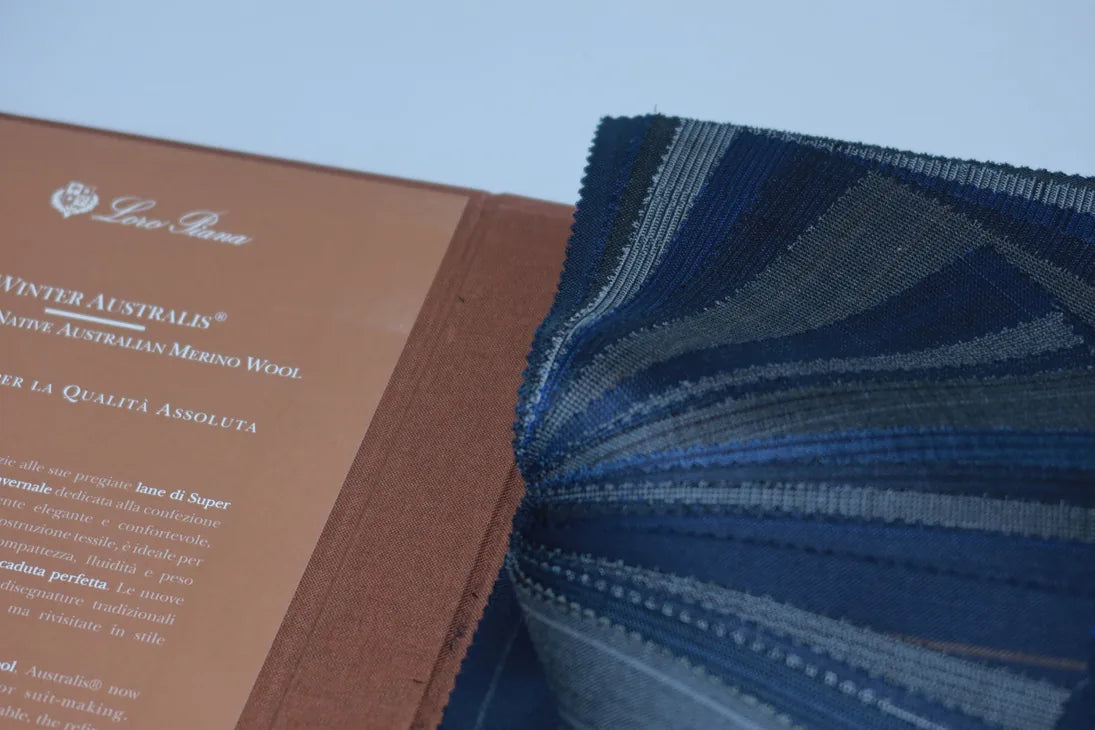
Merino is the fine, soft wool of the merino sheep, and the base of most good suiting cloth. Scott calls it the most capable fibre on the table:
“Merino wool is nature’s active fibre.”
It earns that for a suit in three ways. It breathes, so it stays comfortable across a long day. It recovers from creasing, so a jacket that's been sat in looks right again after a night on a hanger. And it springs back into shape, which is what keeps the knees and elbows of a suit from bagging. Scott also points out where it comes from:
“It comes from the merino sheep from Spain, brought to Australia in the late 1700s. We are probably the main source of merino wool in the world.”
The merino is of Spanish descent, though the first ones reached New South Wales in 1797 from the Cape of Good Hope rather than straight from Spain. Today, Australia grows about 90% of the world's wool that goes into fine apparel, by the Woolmark Company's count.
So what's the difference between merino wool and wool? Merino is finer and softer than the wool of most other breeds, which is why it's the suiting standard.
Mohair
Mohair is the hair of the Angora goat: long, smooth and naturally lustrous. According to Scott:
“Mohair is a very luxurious, very fine silky fibre.”
Mohair fibres measure about 25 to 45 microns and get coarser as the goat ages, so the finest mohair comes from young goats. In a suit, it's almost always blended with wool. It adds a dry crispness and a sheen, resists creasing and breathes, which makes wool-mohair a strong cloth for summer and for evening, where the sheen catches the light.
Is mohair itchy? It can feel dry or wiry against the skin, particularly at a low blend percentage where the mohair sits in a softer wool and stands out at the wrist. In a good wool-mohair blend it reads as crisp rather than itchy, and it's worn over a shirt in any case. It also looks shinier in daylight than some men expect, so it's worth seeing a swatch outside before you decide.
Cashmere
Cashmere is the fine undercoat of the cashmere goat, most of it from China and Mongolia. The fibre is combed or shed from beneath the coarser outer hair, which is part of why so little of it comes from each animal. To be sold as cashmere in the US, the fibre must average 19 microns or finer.
In tailoring, it's the softest of the common fibres, with a drape nothing else matches. That softness has a cost: pure cashmere pills wherever it rubs, under a shoulder bag, against a seatbelt or along the inside of the sleeves. That's why pure cashmere isn't a daily-wear suiting cloth. A wool-cashmere blend gives most of the softness with far more wear, and it's the version to ask for in a jacket or a coat you'll reach for often.
Vicuña
Vicuña is the fleece of the vicuña, a wild relative of the llama and alpaca that lives high in the Andes. Scott doesn't undersell it:
“Vicuña wool is by far the most luxurious, most expensive and most rare material you can get your hands on.”
It's rare and expensive for a reason. The animals are wild and protected, they can only be shorn every two to three years, and each one yields only a few hundred grams of usable fibre. In Peru, they're rounded up in a traditional gathering called the chaccu, shorn, and released back into the wild. That's why vicuña tops any list of the most expensive wool.
The fibre measures about 11 to 13.5 microns, finer than cashmere. So is vicuña better than cashmere? Finer and rarer, yes. Better for everyday tailoring, no. It's a cloth for a jacket or coat you'll treat with care, not one for the daily commute.
Baby Camel Hair
Baby camel hair is the soft undercoat of the Bactrian, or two-humped, camel of Mongolia and China, gathered when the camels moult. "Baby" names the finest, softest grade of that undercoat. Sources disagree on whether it always comes from young camels, so it's best read as a grade rather than an age.
It's used for overcoats above all, and for some jackets. Its natural colour is the golden brown that gave "camel" its name as a colour, and a coat in undyed camel hair has a warmth to it that dyed wool doesn't quite match. On why people pay for it, Scott's answer is simple:
“It is one of those things you are willing to fork the money out because it’s quite a status symbol to have something of that magnitude.”
It's worth knowing that many "camel coats" in shops are camel-coloured wool, not camel hair. The label will say which.
Tweed and Worsted: A Cloth and a Yarn
These two appear on suit labels next to the fibres, but they aren't fibres. One is a cloth, and the other is how the yarn is spun.
What Is Tweed?
Tweed is a rough, dense, warm cloth woven from woollen-spun wool, first made in Scotland for country and sporting wear. So what's the difference between wool and tweed? Tweed is made of wool. It's the cloth, not the fibre. Scott on what it's like to wear:
“It keeps you extremely warm, it is dense, it has little fibres that pop off, that’s usually what people see as texture.”
Its colours were traditionally drawn from the landscape it was worn in. Harris Tweed, woven in the Outer Hebrides, takes its reds from island flora, its greys from the local rock, and its earthy tones from lichen and moss, so a single yarn can carry several colours at once.
In tailoring, tweed belongs in sports jackets and winter suits. It's too warm for most of a Sydney year, so it earns its place on cold mornings, in the Southern Highlands, and on trips to cooler cities.
Worsted Wool
Worsted wool is spun from long fibres that have been combed straight before spinning, which gives a smooth, strong, fine yarn. Woollen yarn is the opposite. It's spun from shorter fibres that are carded but not combed, so it's fuzzy, airy and warm, and it's the yarn in tweed and flannel.
Worsted spinning uses fibres of roughly three inches, about 75 millimetres, and longer. The exact threshold varies between sources, so treat that as a rule of thumb rather than a cut-off.

It matters because worsted is the yarn behind most business suits. The combed fibres lie parallel, so the cloth takes a crisp press, holds a sharp crease and shows a pattern cleanly, from a fine pinstripe to a subtle check. When a suit looks smooth and sharp from across a room, worsted spinning is most of the reason.
One note on the word: "worsted" in knitting means a yarn thickness, which is unrelated to the suiting cloth.
Choosing Your Wool With Lupo Bianco
Each fibre does a different job. Merino carries most suits, mohair keeps one crisp in the heat, cashmere softens a jacket or coat when it's blended with wool, and the rarer hair fibres belong in garments you'll treat with care. The right one depends on what you're making and how often you'll wear it.
The easiest way to choose between them is to handle them. Book a fitting and we'll put the cloths in front of you, so you can feel the difference before you decide on your custom suit.